
Continued from Part 1: Perseid Meteor Shower (and a Muon):
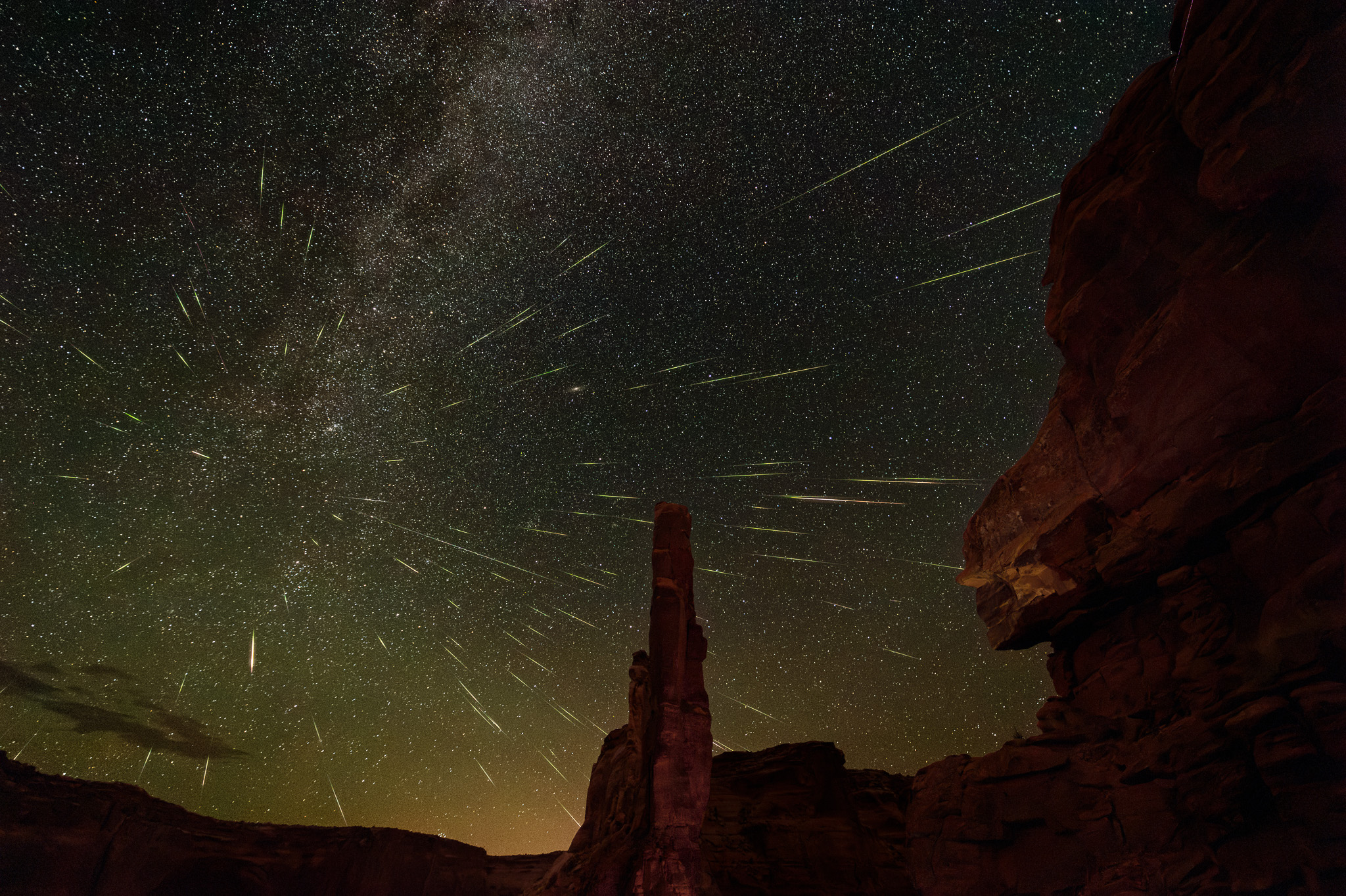
Back to the ‘Happy Accident’… On this particular night it came in the form of a cosmic ray captured by the camera during a timelapse up near the saddle below Zeus (you may have noticed an oddity in the lower left corner of the image in the previous Perseid Meteor Shower post). The above composite used a timeframe that centered upon the capture of the muon, which occurred at 00:42:46 hrs MDT; this base image (containing the muon) shows different sky coloration due to the airglow that varied throughout the night. Only 126 Perseid meteors were captured in this particular field of view during this time interval.
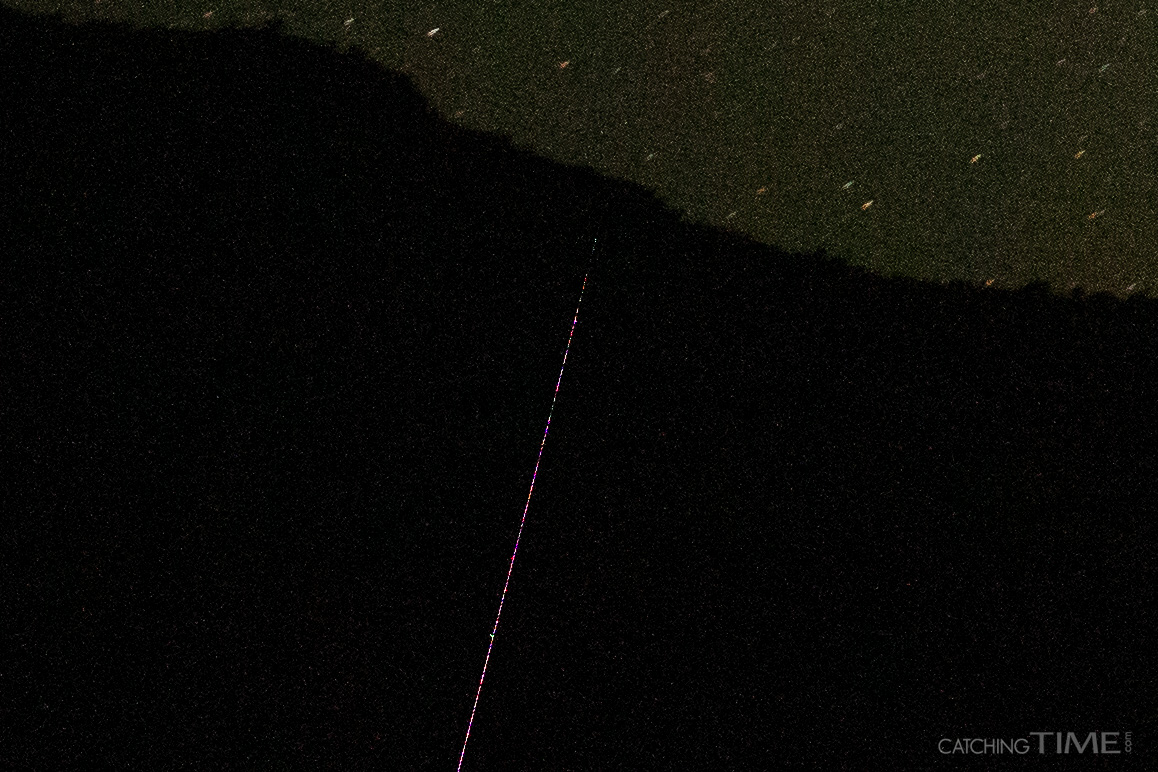
When first processing the Perseid timelapse images I found what appeared to be an errant streak of light below the canyon rim, aligned nearly exactly toward the meteor shower radiant. One might first casually assume it to be a meteor that was captured below the dark horizon due to its nearly perfect orientation toward the radiant, but I intuitively know how astronomically unlikely that would be–impossible, really–since small meteor(ite)s likely never emit light by the time they have descended to the ground surface. So, I went in search of an answer, first consulting an acquaintance (user: Snapsy) on the FredMiranda.com website who is well-versed in CMOS sensor tech. After a bunch of back-and-forth, someone else (user: Kameratrollet) mentioned that it might be a ‘muon’, thus sending me down a deep rabbit hole to confirm if this apparent artifact was indeed some sort of cosmic ray. The primary indicator suggesting a cosmic ray was that it was only a single pixel wide, and thus could not be an optical phenomenon, which would have been smeared over adjacent pixels due to lens aberrations.
After a few hours of investigation, I found the first source that possibly confirmed it as a cosmic ray, a paper by Tomasz Hachaj (Faculty of Electrical Engineering, Automatics, Computer Science and Biomedical Engineering, AGH University of Krakow, Al. Mickiewicza 30, 30-059 Krakow, Poland) and Marcin Piekarczyk, titled “The Practice of Detecting Potential Cosmic Rays Using CMOS Cameras: Hardware and Algorithms“. The paper describes methodology by which off-the-shelf consumer CMOS sensors can be used to capture traces of cosmic rays, and to me mostly confirmed what I had captured. I reached out to Tomasz via email and sent him the image, and while he agreed it’s likely a capture of a cosmic ray, he subsequently reached out to a couple of physics colleagues who specifically research cosmic rays. He then forwarded me this:
“This is the prettiest muon ‘specimen’ I have seen so far 🙂 Your photo might be a wonderful advertisement of cosmic particle research… Here is a commentary by Sławomir Stuglik from Department of Cosmic Ray Research and Neutrino Studies (NZ15), The Henryk Niewodniczański Institute of Nuclear Physics Polish Academy of Sciences:
“The image shown (by Mr Jeff) is the best example that any device with a CMOS sensor is capable of seeing secondary cosmic radiation (CR). The trace (in terms of shape) is very similar to one of the three main shapes we have on smartphones (thanks to the CREDO Detector App). The dashes always represent particles with higher energies and are mainly muons. The “track” trace is created because of the CR particle hitting at an angle (other than 90 degrees) the dozens of sensitive (energy, light) elements of the matrix. This image is additionally very interesting in that the particle track is long and visible despite the lack of camera coverage.”
The main body of work describing the physics and capture of such cosmic traces on CMOS sensors can be found here: “Cosmic Ray Extremely Distributed Observatory“, P. Homola, et al. (CREDO Collab.), Symmetry 2020, 12(11), 1835, 2020. [arXiv:2010.08351, DOI:10.3390/sym12111835].
Regarding cosmic rays and muons, from Wikipedia:
Secondary Cosmic Radiation occurs when cosmic rays enter the Earth’s atmosphere and collide with atoms and molecules, mainly oxygen and nitrogen. The interaction produces a cascade of lighter particles, a so-called air shower secondary radiation that rains down, including x-rays, protons, alpha particles, pions, muons, electrons, neutrinos, and neutrons.[72] All of the secondary particles produced by the collision continue onward on paths within about one degree of the primary particle’s original path. Some high-energy muons even penetrate for some distance into shallow mines, and most neutrinos traverse the Earth without further interaction. Muons can be easily detected by many types of particle detectors, such as cloud chambers, bubble chambers, water-Cherenkov, or scintillation detectors.
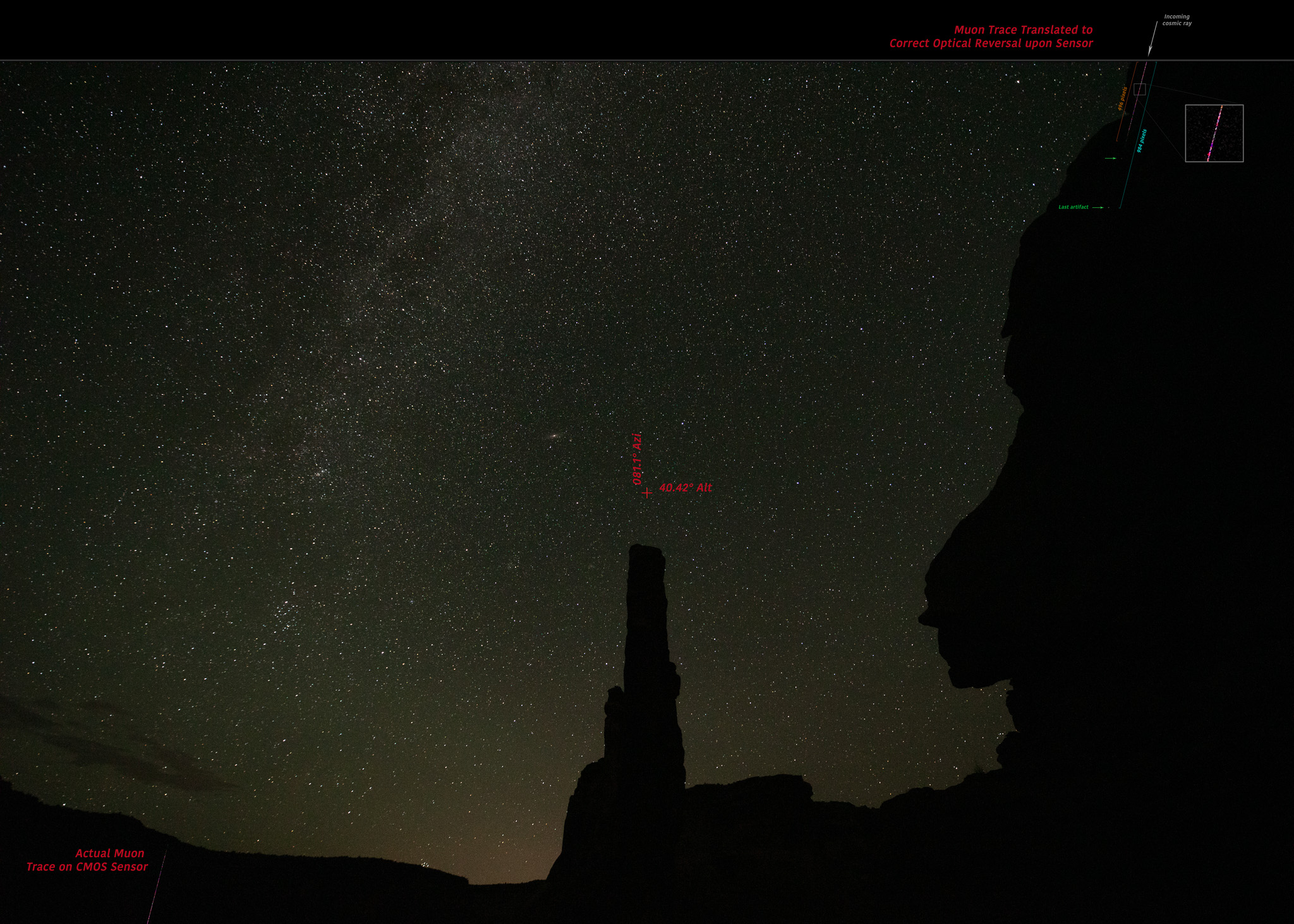
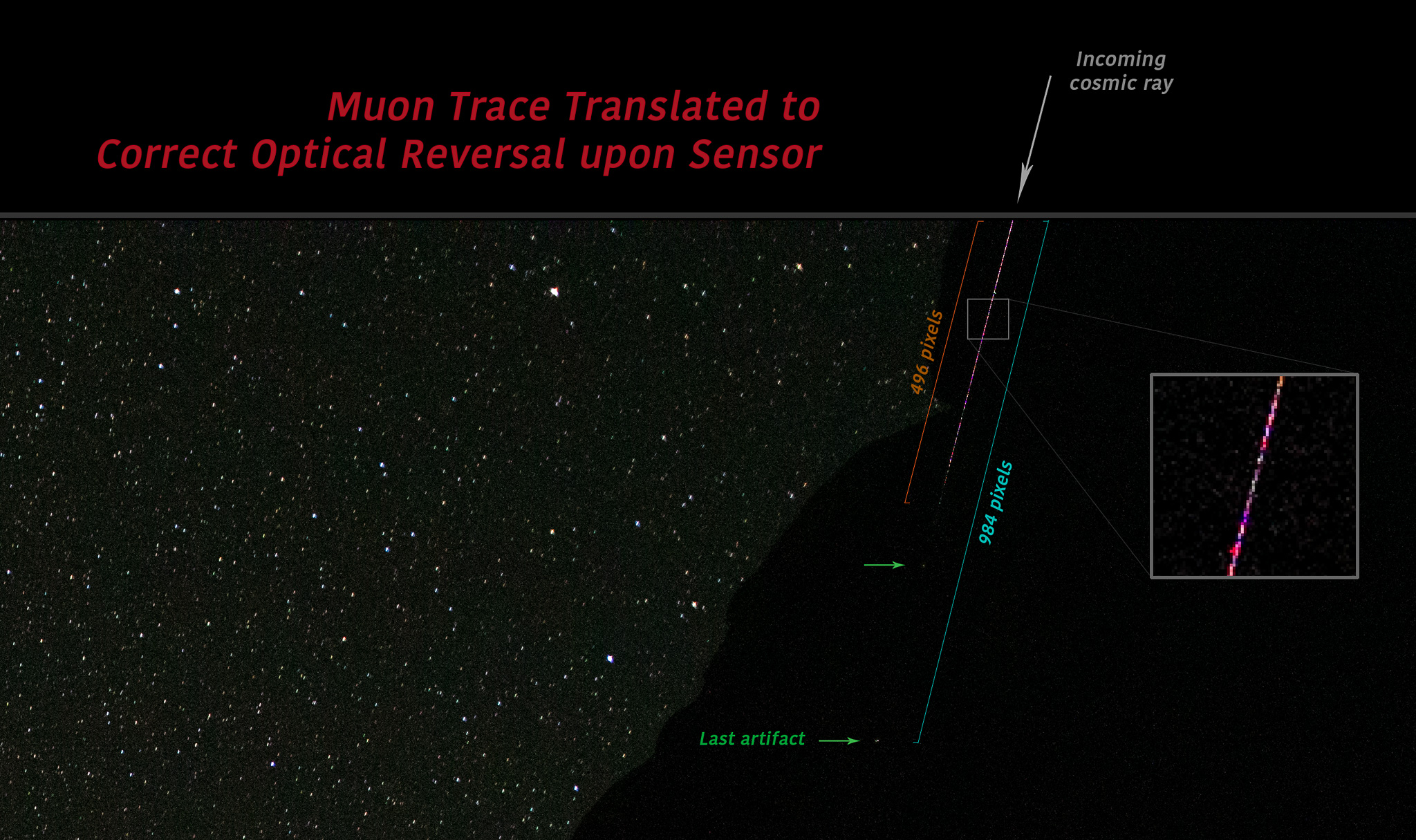
As Mr. Stuglik noted above, the unique aspect of the capture is the sheer length of it, apparently being much longer than most captures observed to date. The continuous trace spans 496 pixels in height and is perfectly linear (as expected), while the length from the first artifact to the bottom of frame is 984 pixels in height. Most traces of muons on CMOS sensors are irregular dots or small ‘squiggles’, infrequently short lines. The dots and squiggles are produced when a ray hits the sensor obliquely (roughly perpendicularly), while a line is produced only when the ray strikes the face of the sensor in a near-parallel orientation, much less likely than the former instance.
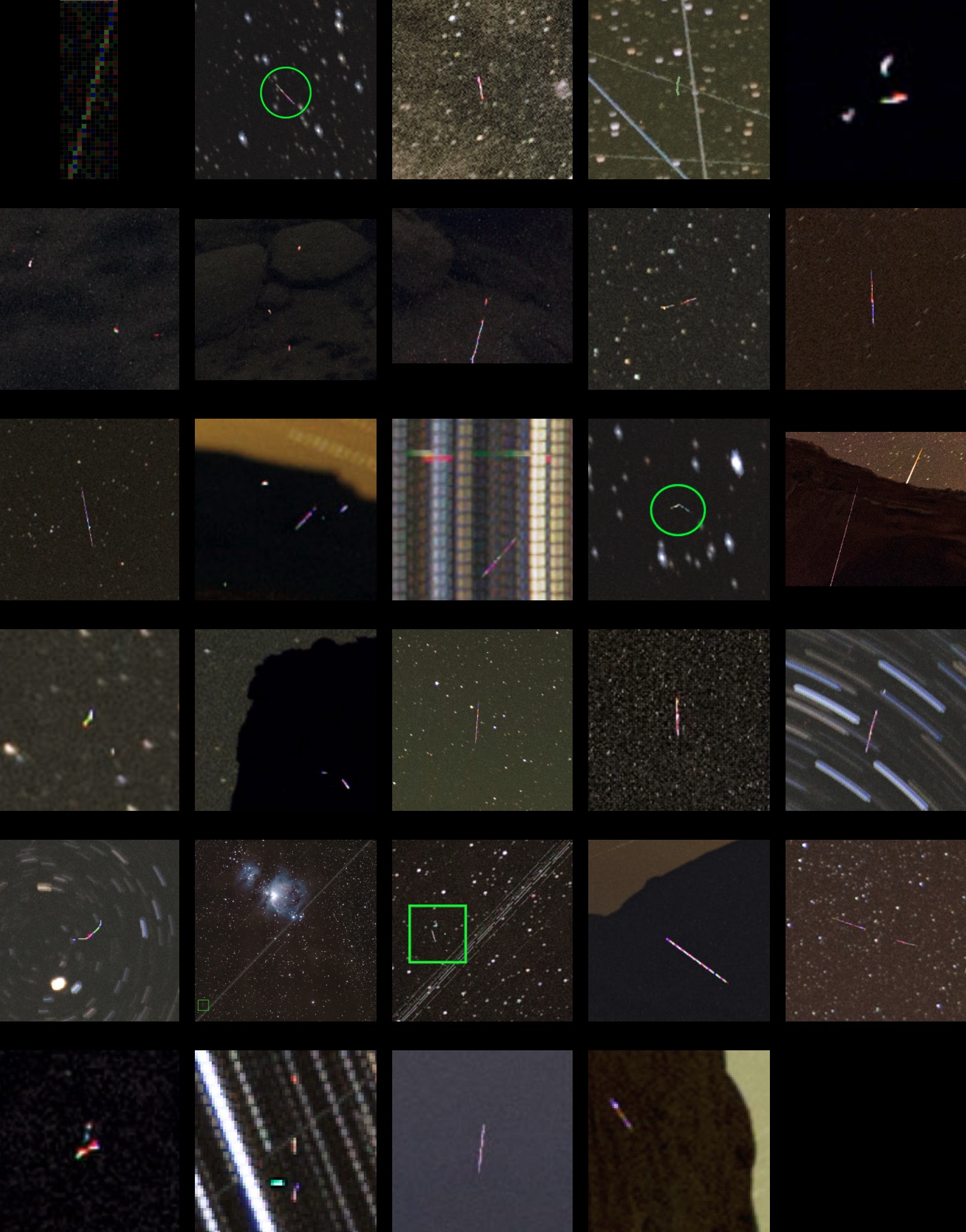
Once I knew what I was seeing, I’ve since noted muons of various sorts in many timelapse sequences I’ve captured over the last few years, hundreds of the ‘dot/squiggle’ type, while the more rare ‘lines’ I usually screenshot when I find them:
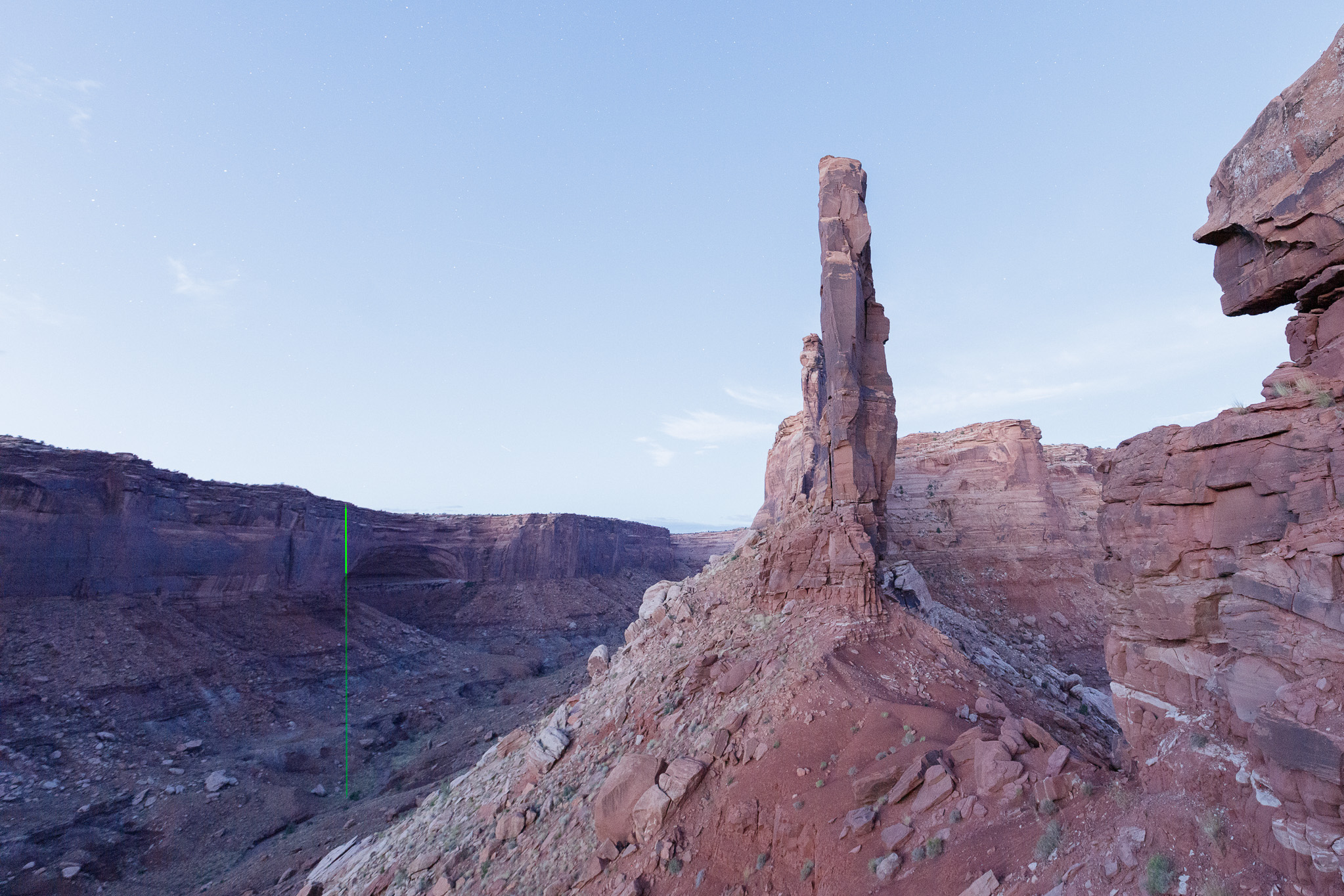
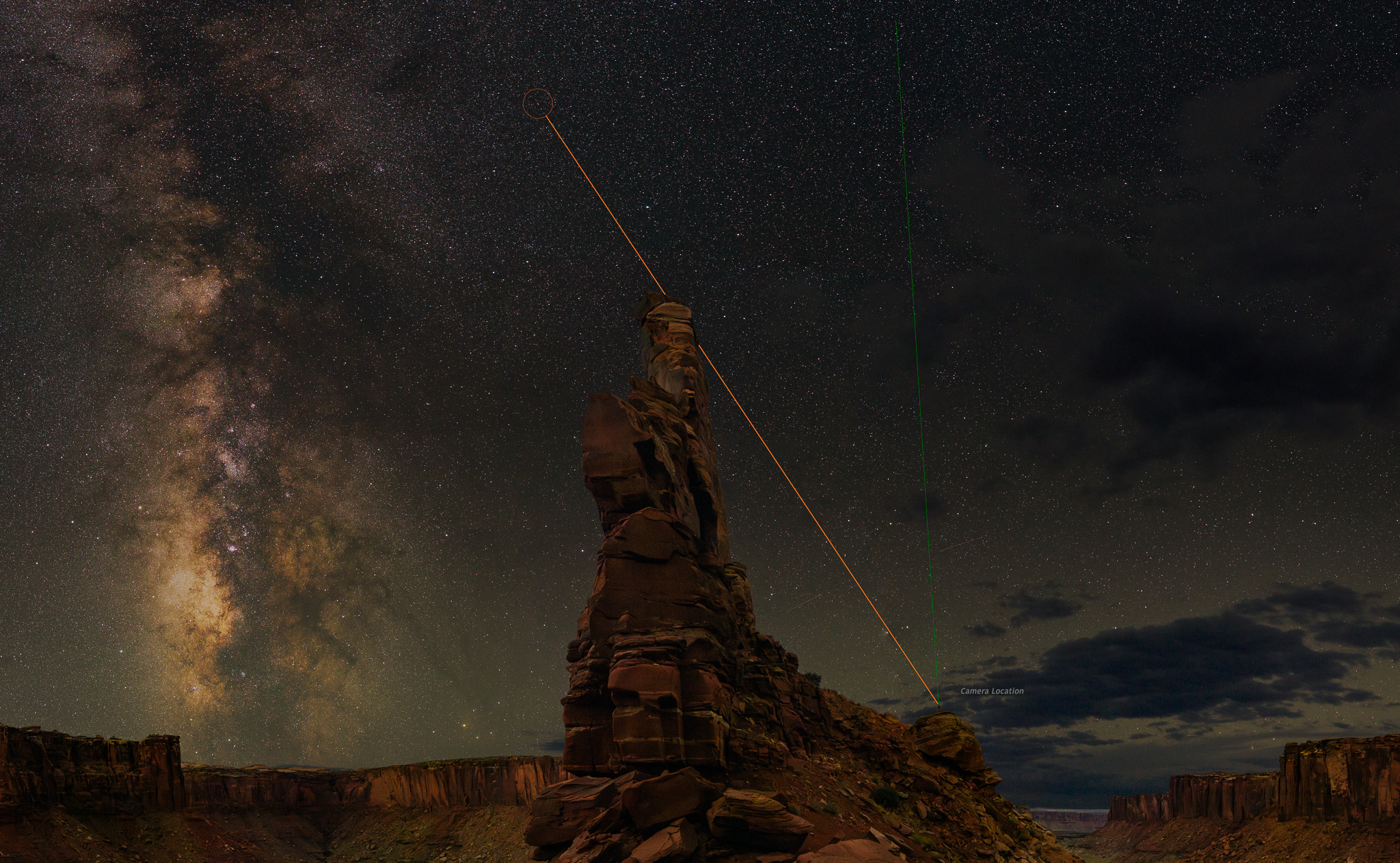
As an idle curiosity, the other thing I took a moment to evaluate was the angle of the muon in the image. Since the ultra-wide angle lens I was using was pointing upwards to capture as much of the sky as possible, I knew that the sloped angle was not accurate, due to field of view distortion. I increased the exposure of the source image to be able to discern topographic details of the canyon wall, and then overlaid the line onto a base image of the foreground that was captured with the camera level. The translation (green line) does not point to the spot on the ground where the muon hit, but rather demonstrates that the muon’s path was nearly vertical when it hit the sensor of the camera (see green line, below canyon rim):
Or so I thought. I then realized that I had forgotten to take into account the fact that camera optics reverse the image (both vertically and horizontally) as projected onto a camera sensor, Basic Photography 101. Sometimes you get so far down rabbit holes that you lose sight of the forest the… weeds, I guess.
The following image shows both the muon as manifested upon the camera sensor (bottom left corner), and the muon translated to the part of the image view that it actually came from, e.g. the upper right corner:
The detail below illustrates the unusual length (as Mr. Stuglik noted above) of the cosmic ray’s path on the sensor, nearly parallel to the plane of the sensor:
My curiosity once again got the best of me, so I tried to determine the general source direction/path of the muon. The camera was pointed at 081° azimuth, and tilted 40° upwards from level, while the muon was 14.6° from ‘vertical’ (relative to the ‘upward’ direction of the sensor plane), off to the right. As best I could, I plotted this vector upon a panorama (captured 30 minutes earlier using a different camera) which included within its field of view the tripod-mounted camera that captured the muon (bottom center-right, in the image below). The orange line shows the approximate source vector of the muon, while the green line approximates ‘camera sensor vertical’, taking into consideration that the camera used for the panorama was not centered with respect to the location of the camera shown in the image.
As an aside, in the ‘Correlation is not Causation’ category, it is sheer coincidence that:
- The muon initially appeared aligned on the sensor almost precisely back toward the Perseid radiant, and (oddly and fortunately) mostly only appears in the part of the image that is black, the silhouetted foreground;
- The bright bolide meteor appeared nearly perfectly parallel to the trace of the muon (see main composite image in previous blog post);
- The translated ‘path through the air’ that I initially projected onto the foreground was nearly perfectly vertical (it certainly was not, once I realized I needed to translate the muon to be optically/visually correct), and
- On the way to the camera sensor, the apparent path of the muon whizzed right past the top-most portion of ‘Zeus’, the often misidentified sandstone spire that stands prominently above Taylor Canyon, as seen from the spur road at the northwest end of the White Rim Trail.
As related to #4 above, I have to note that in Greek mythology, Zeus frequently threw thunderbolts as his primary weapon to enforce law, order, and justice; forged by the Cyclopes, these bolts were used to punish mortals, giants, and other gods who defied him. Thusly, a negatively-charged subatomic (electric) particle came down from the direction of the mythical god Zeus, and intersected the plane of my camera sensor in an unfathomably improbable combination of orientations. And all this, in a locale that is perhaps my most revered ‘temple’ in all the amazing places on earth I’ve been, during one of the most strenuous photographic efforts I’ve ever undertaken, on one of the hottest days of the summer, resulting in finally capturing an image that was more than 5 years in the making.
All a bit weird, yes. Related, obviously not.
Probably more than most would ever want to know about the random capture of a cosmic ray, but it’s pretty fascinating that invisible things originating far out in deep space can be captured by everyday camera sensors that are ubiquitous to cellphones.
Pingback: 8/12/23: Perseid Meteor Shower (and a Muon) - CatchingTime