
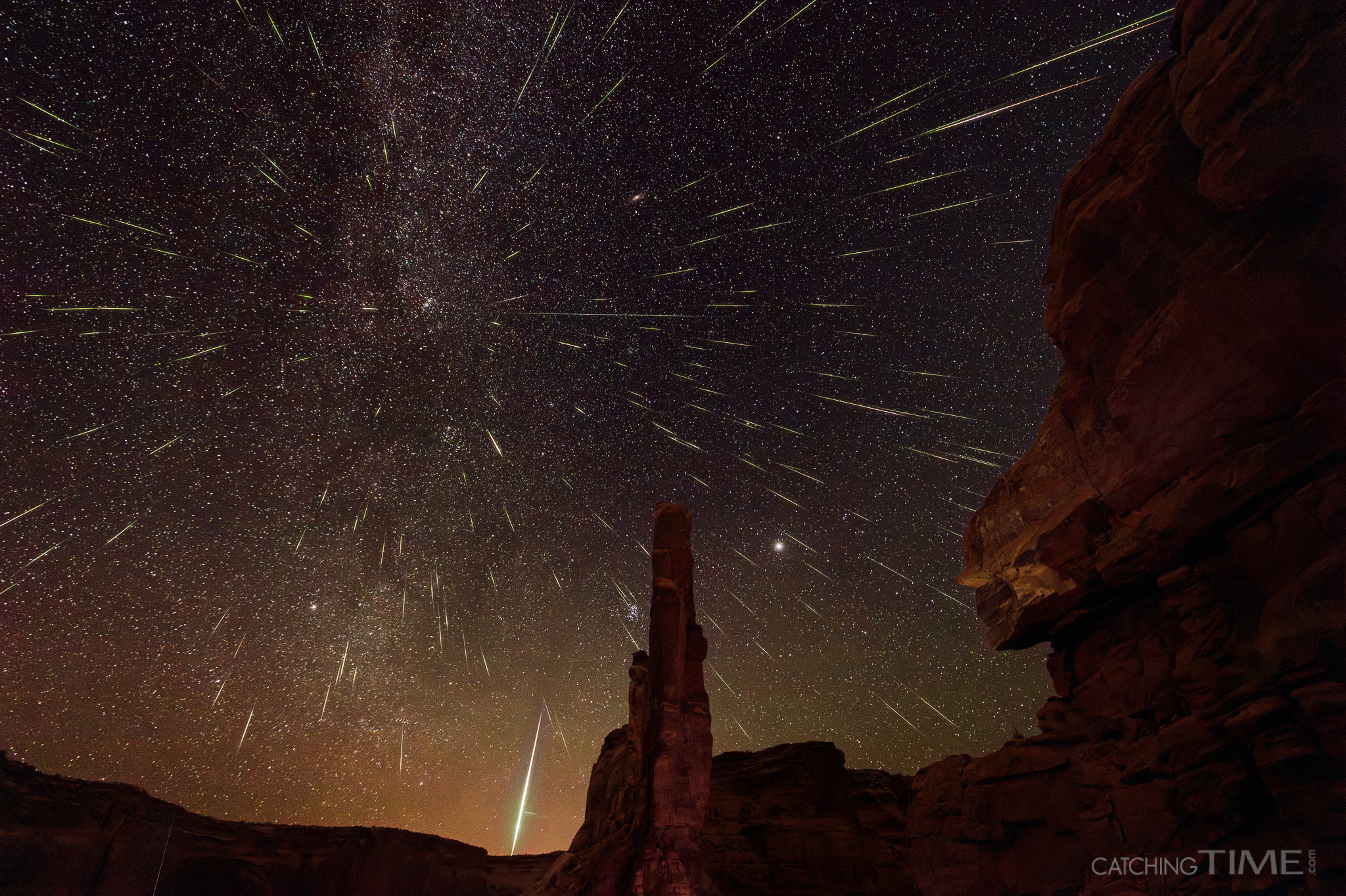
Despite oppressively warm temperatures in the southwest desert, I spent three days deep in Canyonlands National Park to capture the 2023 Perseid Meteor Shower. Daytime highs while I was there ranged from 102-108.4°, and this was the first time I’d endeavored to exist outdoors for days in such temperatures. It was every bit as difficult as I’d imagined, as there was no cloud cover whatsoever on the two hottest days. It was also every bit as rewarding as I’d hoped, considering the effort I’ve expended over the years, trying to get this particular image of the Perseid Meteor Shower. My first attempt back on 8/13/2018 started with clear skies as twilight faded, but was foiled by wildfire smoke that came in from the northeast just as night fell, and got only one meteor, almost immediately after I started the camera. After I’d placed the cameras and was hiking down from Moses & Zeus, I started to smell smoke, and by the time I got back to camp, the sky in the direction of Perseus was all but invisible. I digress.
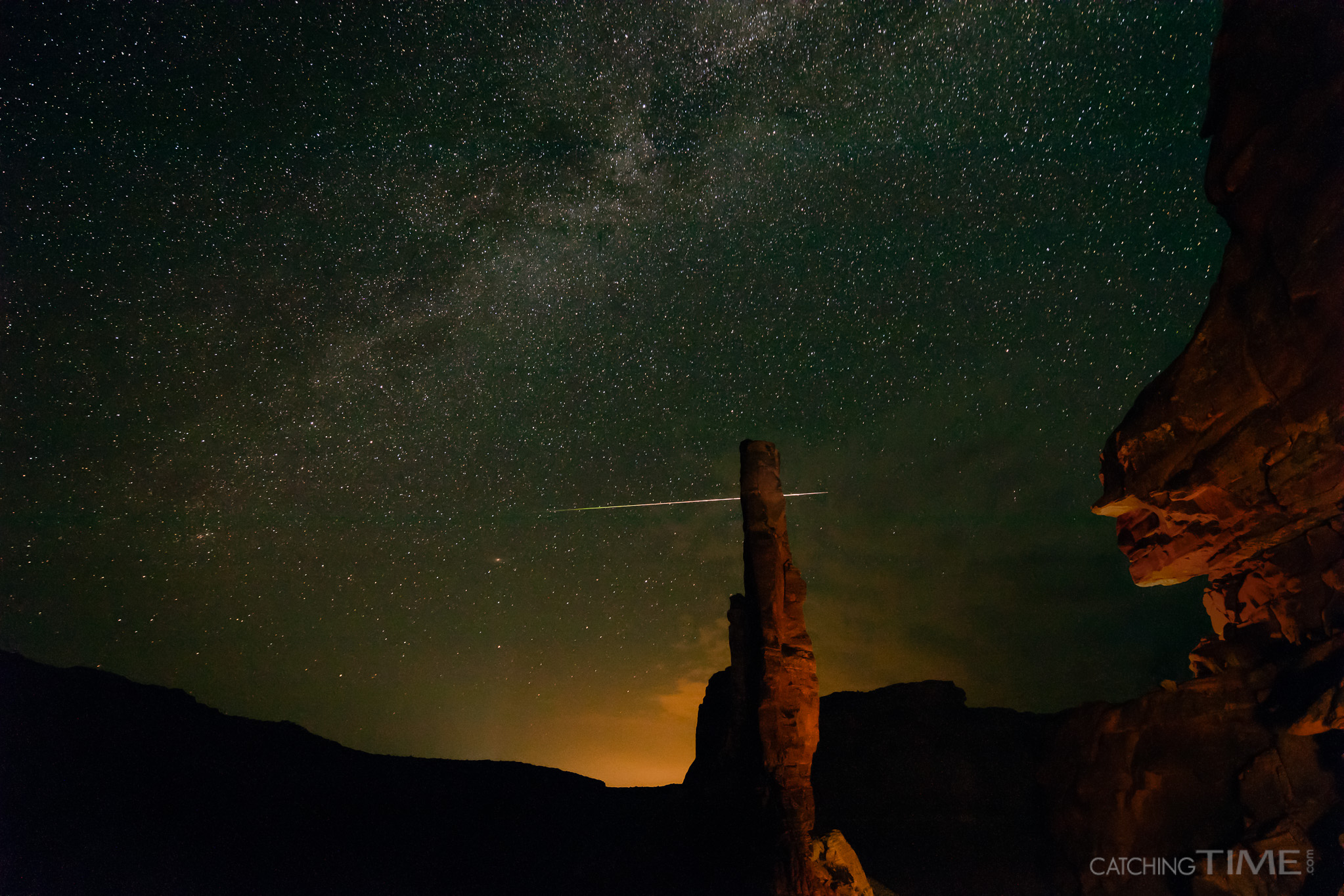
On this night in 2023, skies were clear and moonless for this primary night of the Perseid Meteor Shower, the most prolific of all the annual displays. The Perseids are characterized by abundant, often long-track green to orange meteors, with occasional bolide meteors, meteors that are exceptionally bright; you can’t miss one if it’s in your field of view. Fireballs, the brightest of bolide meteors, can leave trails of ionized gases in the upper atmosphere (‘Persistent Trains’), that can be observed in timelapse sequences for nearly an hour. You can see an example of a persistent train that I captured from Valley of the Gods, UT here. Two bolides were captured on this night, both of which can be seen in the image (one short, one long). Notably, the largest bolide captured was not a Perseid, and thus could not be aligned to the radiant in the vicinity of Perseus constellation; I have left this bright meteor in its original orientation, as captured (at 3:10 AM).
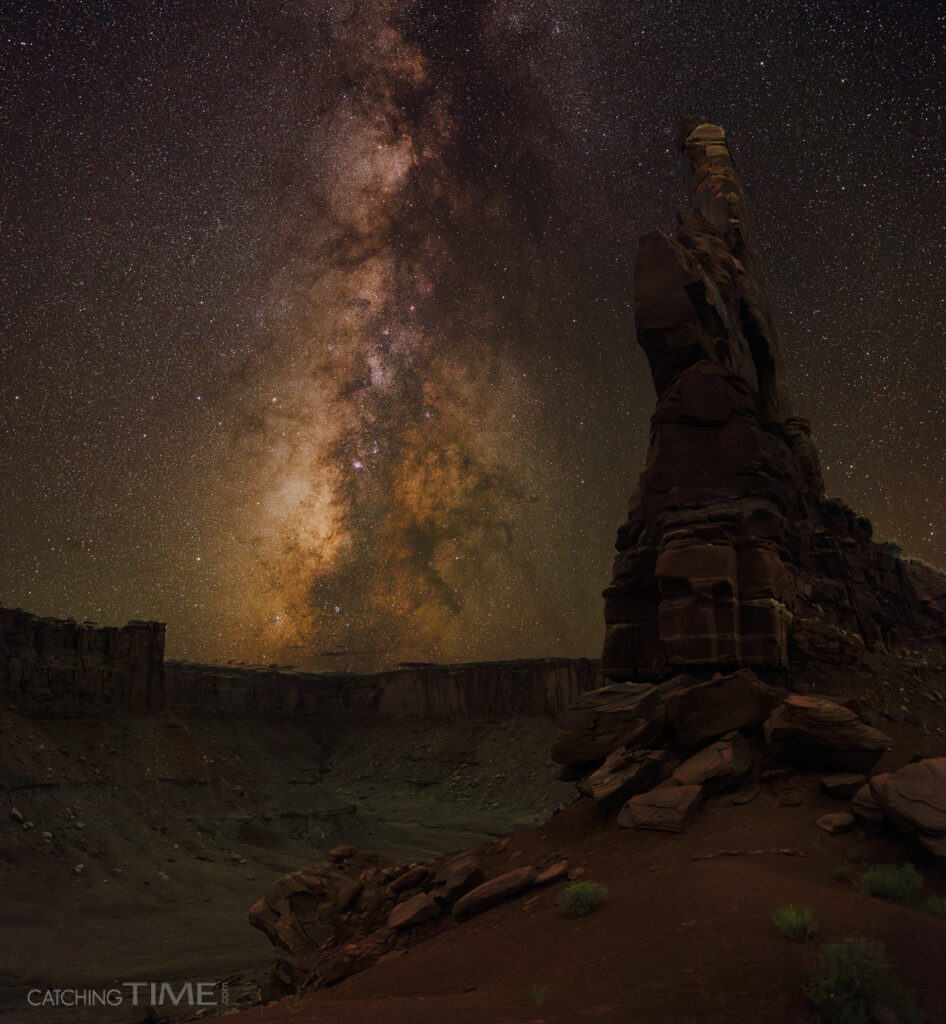
The hike to the saddle between Aphrodite and Moses & Zeus is 1.5 miles one-way on a primitive trail, the upper reaches of which which can be eventful to follow even in the daytime. Carrying nearly 65 pounds of photo equipment (two tripods, two cameras, four lenses, a star tracker, Garmin InReach and gear) was near the limit of my aged ability, especially given that it was still in the high 80s when I departed camp. Once I arrived after nearly an hour of scrambling, I first set up the time-lapse camera on a rock platform below Zeus that I’d used 5 years prior, and then headed to the saddle to capture some panoramas. As I was shooting my first foreground, I happened to see a Starlink Train (a recent launch of Starlink satellites), which I was able to capture a proper image of the following night. Once I was done with the pano captures, I set up the Star Tracker to capture the Milky Way, framed by Moses and Zeus, the two spires of sandstone that sit regally above Taylor Canyon:
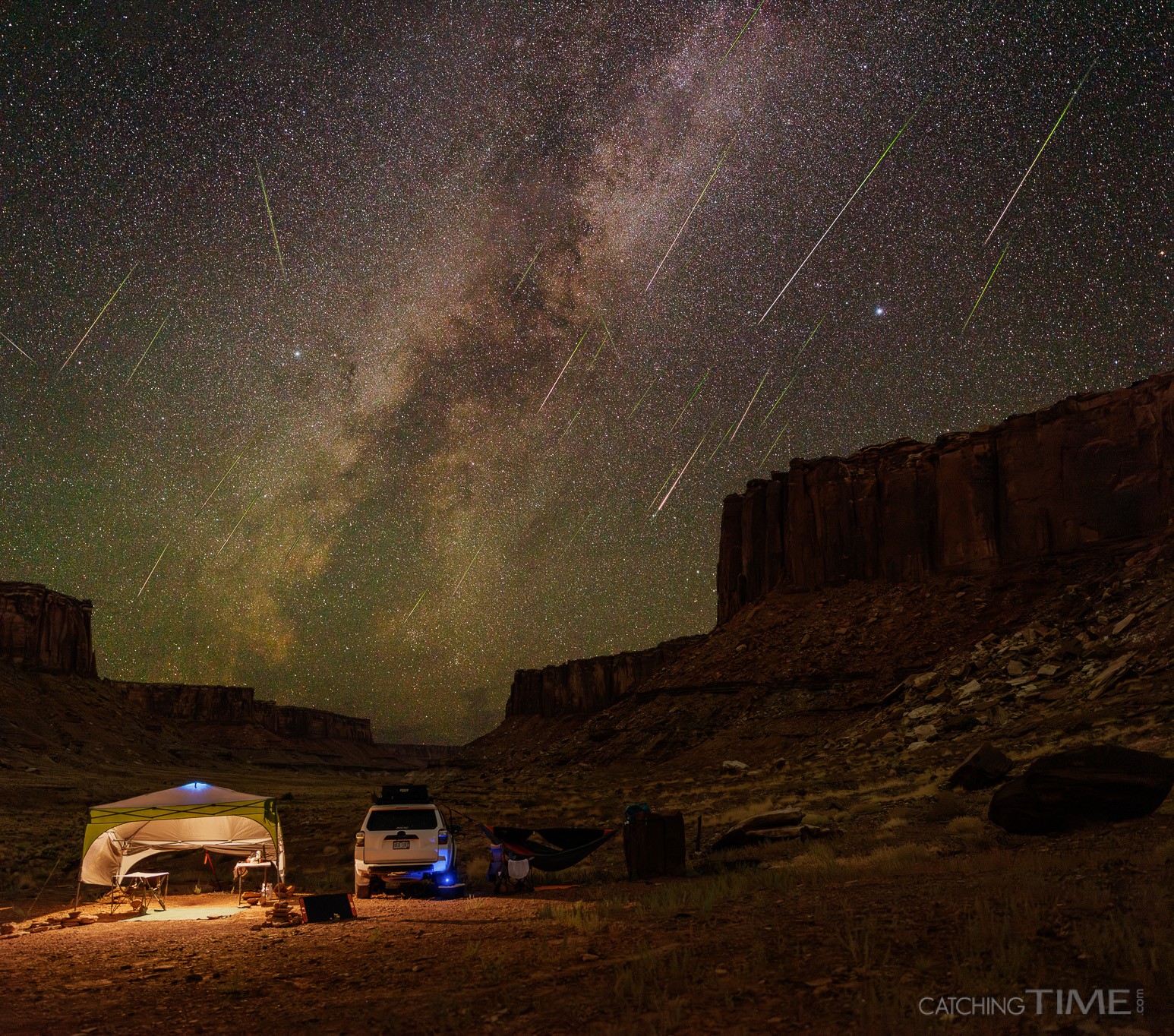
After hiking back down to Taylor Camp (yes, permit required, always!), at around 2:00 AM I set up the Canon R5 to capture meteors on the opposite hemisphere of sky from where they were emanating. This approach of facing away from the radiant tends to capture long meteors that track nearly parallel with respect to each other, and is thus fairly easy to hand-composite afterwards (meteors not aligned, but kept in place):
Some data on the main meteor composite image shown at the beginning of this post:
- 22:53 to 4:08 hrs MDT = 5h15m of exposure time
- 583 images from Canon 5Ds
- Exposure: 13s, f/2.2, ISO 4000
- Lens: Sigma 14mm f/1.8 Art
- 186 Perseid meteors captured (37-62 meteors/hour)
- 47 non-Perseid meteors captured (only one shown in composite)
As occurred back in April of this year when I stumbled across flaring Starlink satellites for the first time, ‘happy accidents’ seem to occasionally come with large amounts of nighttime effort, which certainly describes these three days in Taylor Canyon. Part 2 of this post will go into detail about the aberration captured in the main meteor shower composite image…
Pingback: 8/13/23: Part 2 - The Muon - CatchingTime